The Hybrid Leadership System™: 8 Questions Every Leader Needs to Answer in the Age of AI
Discover the eight frameworks of the Hybrid Leadership System™ and how leaders can use them to navigate decisions, governance, organization design and human + AI collaboration.
AI is changing faster than most leadership models. That is the real problem.
Most organizations are already experimenting with AI. Many are deploying tools, automating tasks, redesigning workflows and asking teams to become more productive.
But the deeper question is often left unanswered:
How should leadership itself change when intelligence is no longer exclusively human?
That question sits at the heart of The Hybrid CEO.
The book is not primarily about artificial intelligence. It is about what happens to leadership when AI starts participating in analysis, recommendations, forecasting, prioritization, decision-making and organizational learning.
That is why I created the Hybrid Leadership System™.
Not as a collection of diagrams.
Not as a consulting gimmick.
But as a practical operating system for leaders navigating a world where intelligence is increasingly shared between people and machines.
The system is built around eight questions.
Each framework answers one of them.
Together, they form a sequence:
MindsetValueDecisionsAugmentationOrganizationOperationsGovernanceMaturity
The point is not that every leader must begin at Framework 01.
The point is that every organization eventually has to answer all eight questions.
The Hybrid CEO Mindset
How must I think and behave differently?
Most leadership models were built in a world where intelligence was scarce.
Expertise was concentrated.
Information moved slowly.
Authority often followed access to knowledge.
AI changes that.
When analysis becomes faster, expertise becomes more accessible and recommendations can be generated on demand, leadership cannot rely on the same assumptions.
The Hybrid CEO Mindset is about six shifts:
- from knowing to learning
- from control to orchestration
- from instinct alone to augmented judgment
- from delegation to ownership
- from efficiency to significance
- from human versus machine to human multiplied by machine
The first shift is perhaps the most important.
Traditional leadership often rewarded certainty.
Hybrid leadership rewards the ability to update beliefs.
A leader no longer needs to be the person with the most answers.
They need to be the person capable of asking better questions, challenging assumptions, integrating multiple sources of intelligence and making responsible choices under uncertainty.
That changes the role of the executive.
The leader becomes less of a gatekeeper of knowledge and more of an orchestrator of judgment.
The Human × AI Value Equation
Where does human + AI collaboration actually create value?
The next leadership mistake is assuming that more AI automatically means more value.
It does not.
The value of AI depends on where it is used, how it is combined with human capability, the quality of the context and the level of trust around the system.
The Human × AI Value Equation is built around four factors:
Human Value × AI Value × Context × Trust = Hybrid Value
The multiplication matters.
If any one of those factors approaches zero, total value collapses.
A technically powerful system with no trust creates little sustainable value. Strong human judgment applied to poor data can still produce poor decisions. Automation in the wrong context can destroy value rather than create it.
The framework helps leaders distinguish four broad zones:
- Automate
- For repetitive, rules-based, low-consequence work.
- Assist
- Where AI helps humans research, compare, monitor or draft.
- Augment
- Where humans and AI shape the outcome together, particularly in complex decisions.
- Elevate
- Where AI creates more space for distinctly human work: leadership, creativity, coaching, innovation, relationships and meaning.
The deeper point is simple:
The objective is not to automate the most work. It is to deliberately decide where humans create value, where AI creates value, and where the combination creates something greater.
The Executive AI Decision Matrix
Who — or what — should decide?
This is one of the most important questions in the entire system.
Too many AI initiatives begin with the technology.
The better starting point is the decision.
Which decisions should AI execute?
Which should it recommend?
Which require genuine human + AI collaboration?
Which must remain human-led?
The Executive AI Decision Matrix looks at two primary dimensions:
- decision complexity
- consequence
It then uses additional filters such as:
- stakes
- reversibility
- uncertainty
- explainability
- human impact
- ethical consequence
- data quality
- speed requirement
The more consequential, irreversible, ambiguous or ethically sensitive a decision becomes, the stronger the human role must be.
The more structured, repeatable, reversible and data-rich the decision becomes, the greater the safe role for automation.
The leadership question is therefore not: “Can AI make this decision?”
It is: “What is the right allocation of authority for this decision?”
That is a much more useful question.
The Leadership Augmentation Loop
How do we make hybrid decisions better over time?
Once decision authority is clear, the next challenge is process.
How should humans and AI actually work together?
The Leadership Augmentation Loop provides a repeatable sequence:
FrameGatherChallengeSimulateJudgeDecideCommunicateObserveLearn
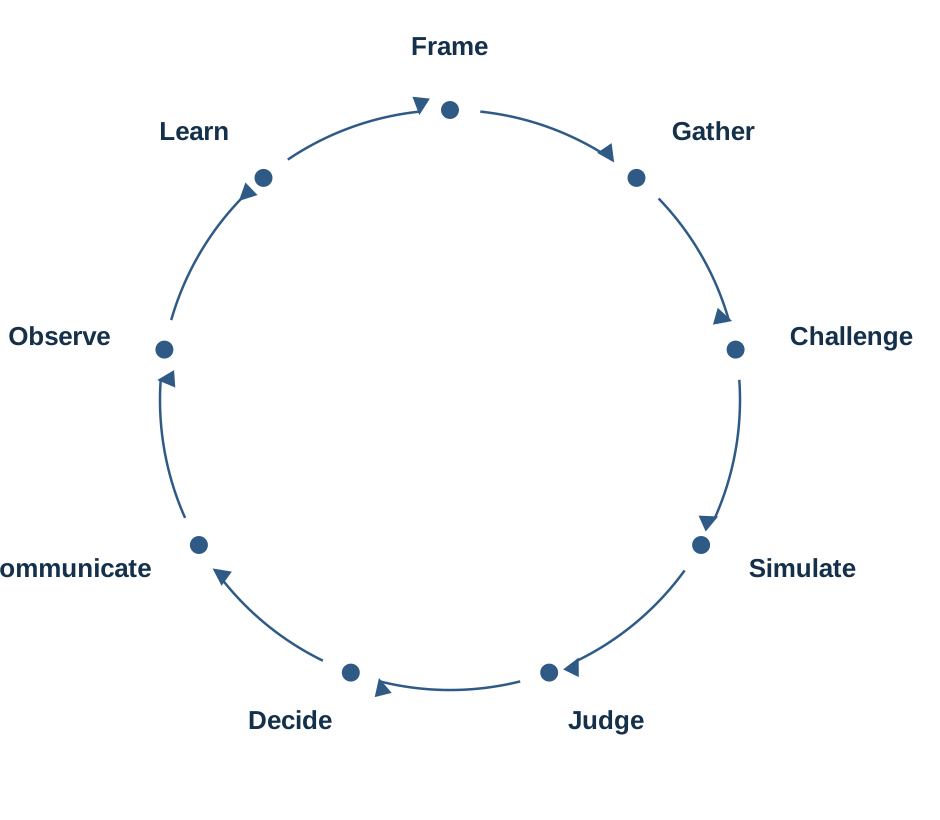
The sequence matters.
A weakly framed problem produces a sophisticated answer to the wrong question. Poor data creates false confidence. Unchallenged assumptions create fragility.
AI can help simulate scenarios, identify patterns and generate alternatives. Humans still apply context, ethics, timing, strategic fit and judgment.
And after the decision, the work is not over. The organization must observe what happened and learn from the outcome.
That makes hybrid decision-making a loop rather than a one-time event.
The goal is not simply better decisions.
It is better decision-making capability over time.
The Hybrid Organization Model
How should the organization itself change?
This is where AI stops being an individual productivity tool and becomes an organizational question.
Most companies are still structured around old assumptions:
- expertise sits in functions
- authority follows hierarchy
- work is organized around fixed roles
- information travels upward
- training happens periodically
- governance follows deployment
AI starts loosening each of those assumptions.
The Hybrid Organization Model examines six dimensions:
- intelligence
- decision rights
- work
- structure
- capability
- governance
A hybrid organization distributes intelligence more widely. Decision rights become more explicit. Work is increasingly designed around tasks, outcomes and capabilities rather than static job descriptions.
Teams become more cross-functional and modular. Learning becomes continuous. Governance becomes embedded by design.
The organizational question is no longer merely: “Where should we deploy AI?”
It becomes: “What kind of organization do we need when intelligence is distributed across people and machines?”
That is a much larger transformation.
The Executive Operating System
How should we run differently every day?
A leadership model is only useful if it changes behavior.
The Executive Operating System translates hybrid leadership into recurring practice.
It focuses on seven operating disciplines:
SenseInterpretPrioritizeDecideMobilizeLearnGovern
And it applies them across different cadences:
- Daily
- Signals, anomalies, immediate decisions.
- Weekly
- Scenario review, priority adjustment, cross-functional coordination.
- Monthly
- Portfolio, workforce, risk and trust review.
- Quarterly
- Strategy refresh, operating model review, maturity assessment.
This matters because AI can increase the speed of sensing and analysis dramatically.
If leadership cadence does not change, the organization becomes faster at producing information but not necessarily faster at making good decisions.
The operating system connects intelligence to action.
It answers a very practical question:
What changes on Monday morning?
The Trust & Governance Framework
How do we remain accountable, trusted and safe?
AI does not remove accountability.
It increases the need for it.
The Trust & Governance Framework asks whether seven conditions are in place:
- purpose
- ownership
- data integrity
- transparency
- explainability
- control
- consequence
For any material AI-supported decision, the organization should be able to answer:
- Who owns the purpose?
- Who owns the data?
- Who owns the system?
- Who owns the decision?
- Who owns the risk?
- Who owns the outcome?
If those roles are unclear, governance is unclear.
The core principle is simple:
Do not blame the machine. Own it. Fix it. Communicate it.
Governance is not the final stage of AI adoption. It is part of every stage.
The AI Leadership Maturity Model
Where are we now — and what should we do next?
The last framework measures leadership capability, not technology adoption.
The five stages are:
- 1. Unaware
- AI is distant, fragmented or poorly understood.
- 2. Experimental
- Pilots exist, but value and governance are inconsistent.
- 3. Augmented
- AI supports selected decisions and roles.
- 4. Integrated
- AI is embedded across workflows, decision rights and operating rhythms.
- 5. Hybrid
- Human and machine intelligence are intentionally designed as one leadership system.
But maturity is not simply an average score.
An organization cannot credibly claim high maturity if:
- governance is weak
- decision ownership is unclear
- workforce capability is low
- trust mechanisms are absent
The real purpose of maturity is not classification.
It is progression.
Where are we now?
What is preventing us from moving forward?
Which framework should we return to next?
That is why Maturity loops back to Mindset.
Hybrid leadership is not a transformation project with an end date.
It is a discipline.
Eight frameworks. One operating system.
The eight frameworks are designed to stand alone. But their real value comes from how they connect.
The Hybrid CEO Mindset
How must I think and behave differently?
The Human × AI Value Equation
Where does human + AI collaboration create real value?
The Executive AI Decision Matrix
Who — or what — should decide?
The Leadership Augmentation Loop
How do we make hybrid decisions better over time?
The Hybrid Organization Model
How should the organization itself change?
The Executive Operating System
How should we run differently every day?
The Trust & Governance Framework
How do we remain accountable, trusted and safe?
The AI Leadership Maturity Model
Where are we now — and what should we do next?
- Mindset enables Value.
- Value identifies Opportunity.
- Decision clarifies Authority.
- Augmentation improves Quality.
- Organization creates Scale.
- Operations create Consistency.
- Governance creates Legitimacy.
- Maturity creates Progression.
And then the cycle begins again.
That is the logic of the Hybrid Leadership System™.
It is not a roadmap for deploying AI.
It is a system for leading when intelligence becomes hybrid.
Why this matters now
Most organizations are already becoming AI-enabled.
Some through formal programs.
Some through individual employee experimentation.
Some through vendors.
Some through customer expectations.
Some through competitive pressure.
The technology is moving regardless.
The leadership question is whether the operating model moves with it.
Because becoming AI-enabled is one thing.
Learning how to lead an AI-enabled organization is another.
That is the gap the Hybrid Leadership System™ is designed to address.
Not by making executives more technical.
By making leadership more deliberate.
More explicit.
More accountable.
More adaptive.
And ultimately, more human.
The leadership question
The most important question is not:
How much AI should we use?
What kind of leadership will we need when intelligence is everywhere?
As intelligence becomes abundant, judgment becomes the executive's greatest competitive advantage.
That is the work of the Hybrid Leader.
And that is the work of the Hybrid Leadership System™.