I Stopped Operating AI. I Started Building an Organisation That Operates the AI.
What one summer of writing books, building products and shipping software taught me about the next operating model for entrepreneurs.
This summer, I did something I could not have imagined doing a year ago.
I wrote and developed three books.
I built and launched two functioning digital platforms.
I worked through product strategy, research, design, code, databases, deployment, content, positioning, testing and publishing.
And I started with precisely zero coding experience.
There was no development team hidden somewhere in the background.
There was me, ChatGPT, Claude, a growing collection of platforms and APIs — and an unreasonable willingness to keep going when something broke.
At first, that felt like the story.
It wasn't.
The more interesting story began when I realised that despite all this extraordinary leverage, I had accidentally made myself the most important piece of infrastructure in the entire system.
I was the person moving information from one AI to another.
I was copying a Claude implementation report into ChatGPT for review.
I was remembering which service ran on Render, which one ran on Vercel, where the database lived, what GitHub repository belonged to which product, what decision we had made three weeks earlier and why.
I was prompting the research.
I was initiating the next task.
I was checking the result.
I was maintaining the context.
I was scheduling the work.
I was the project manager, message bus, memory layer, QA coordinator and integration architecture.
That isn't autonomous AI.
It's an extraordinarily productive human being surrounded by extraordinarily capable tools.
And there is an important difference.
You do not need 50 agents. You need to stop being the integration layer.
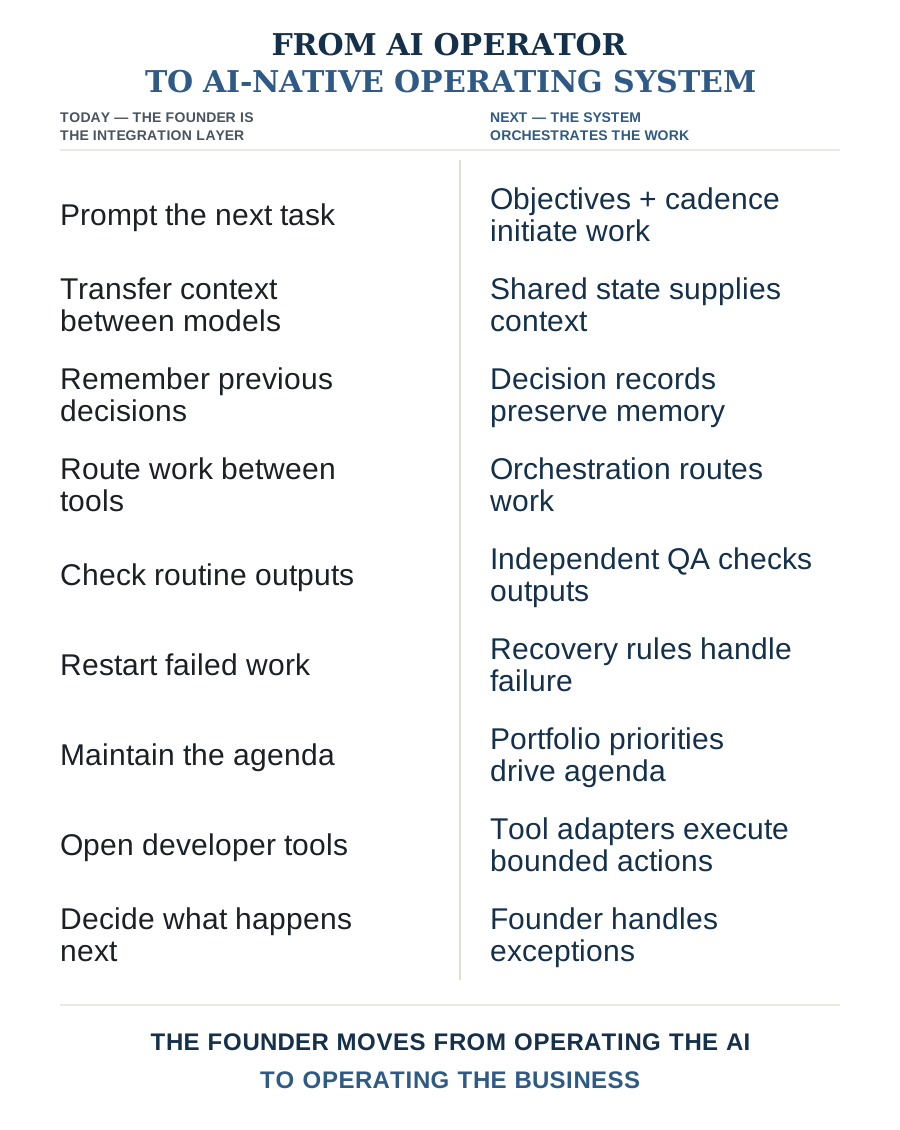
That sentence changed the direction of everything I was building.
From using AI to designing an organisation
Most conversations about AI adoption still begin with tools.
- Which model?
- Which agent?
- Which copilot?
- Which automation?
- Which platform?
Those questions are useful, but I increasingly think they are downstream questions.
The more important one is:
What should the organisation itself look like when intelligence is no longer exclusively human?
That took me somewhere very different.
Instead of asking Claude to do more things, I started asking what role Claude should have.
Instead of asking ChatGPT better questions, I started asking what responsibility it should own.
Instead of creating another automation, I started defining authority.
- Who can make a decision?
- Who can challenge it?
- What requires my approval?
- What should continue if I disappear for three days?
- Where does institutional memory live?
- What happens when two sources contradict each other?
- Who decides that something isn't worth doing?
- What happens when an agent fails?
- How much money can it spend trying again?
At that point, you're no longer designing prompts.
You're designing an operating model.
And that distinction matters.
The model should not be the organisation
One principle became particularly important:
Do not make Claude the boss. Do not make ChatGPT the boss. The shared state and operating rules should be the boss.
Models change.
Providers change.
Capabilities leapfrog one another.
Today's best coding model may not be next year's best coding model.
So the organisation should be built around roles, not brands.
In my emerging system, I remain the founder and final authority.
Below that sits an orchestration layer — essentially a Chief of Staff — responsible for priorities, sequencing, allocation, conflict, escalation and ensuring that the work remains aligned with the objectives.
Below it sit Project Leads.
Below them, specialists: build, research, evidence, QA, red-team, editorial, design, analytics.
And beneath those specialists sit the tools: GitHub, databases, Vercel, Render, Google Drive, APIs, OpenAI, Claude and whatever comes next.
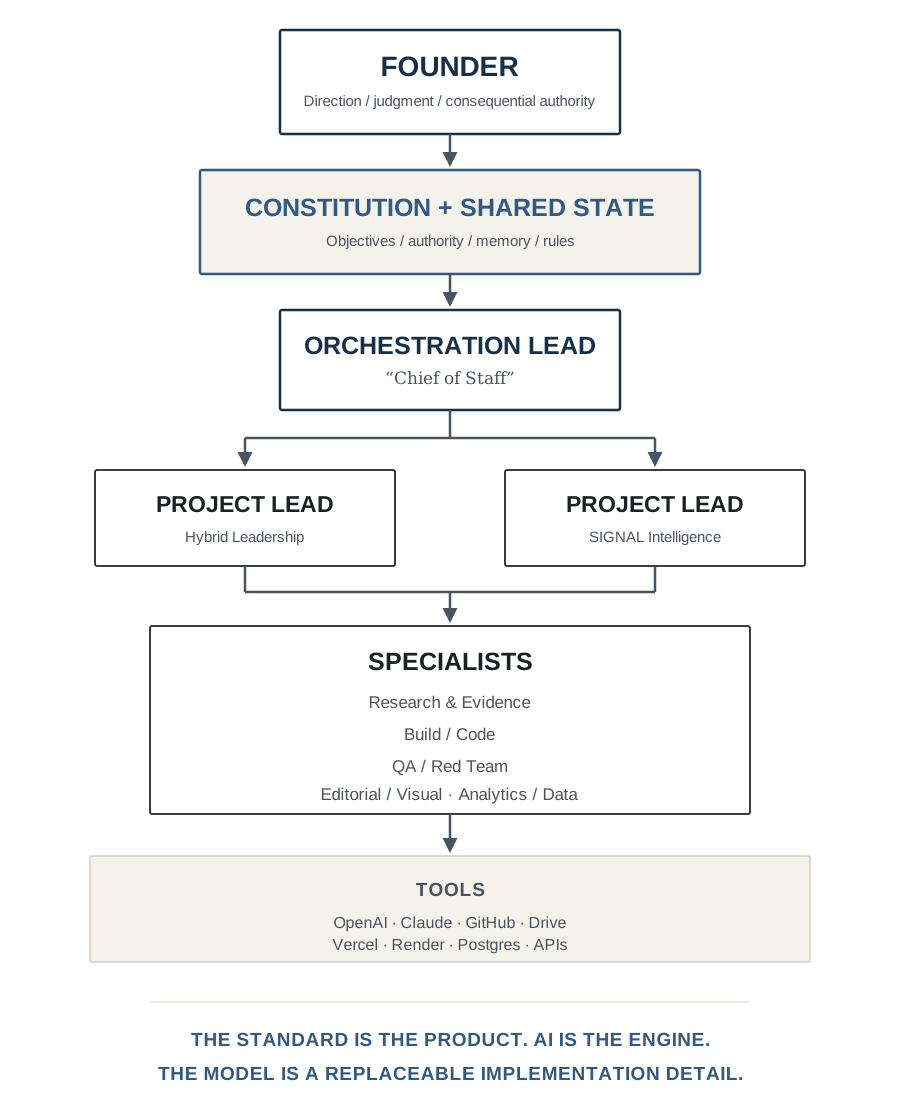
The specific models are implementation details.
The operating model is the durable asset.
I had already written a version of this principle elsewhere:
The Standard is the product. AI is the engine. The model is a replaceable implementation detail.
I now think that idea applies far beyond a single product.
It applies to the company itself.
Management by exception
The consequence is a very different relationship between the entrepreneur and AI.
Today, most of us practice management by prompting.
Nothing happens until we ask for something.
A capable model waits patiently in a browser tab until somebody wakes it up.
The organisation I want instead runs on management by exception.
I determine direction.
I establish priorities.
I make consequential decisions.
I intervene when judgment, risk, contradiction or ambition genuinely requires me.
Everything else should continue.
That leads to a rather severe operating rule:
Anything that requires me to open a developer tool during normal operation is an orchestration failure.
Of course I can open GitHub.
I can inspect Render.
I can look inside a database.
The point is that doing so should be exceptional.
A CEO does not demonstrate effective organisational design by personally checking the server logs every morning.
AI shouldn't suddenly make that good management.
The target is a short mobile briefing:
- What moved?
- What matters?
- What is blocked?
- What genuinely requires me?
- What happens next?
Everything else is available if I want to drill down.
But complexity underneath should not become founder workload.
The organisation needs to keep thinking when nobody prompts it
This may be the biggest conceptual shift.
AI today is overwhelmingly reactive.
You ask.
It answers.
You ask again.
It answers again.
An organisation is different.
It has cadence.
Research happens whether or not the CEO remembers to request it.
Products are reviewed.
Performance is examined.
Assumptions are challenged.
Risks are monitored.
Ideas are revisited.
Evidence gets updated.
The organisation has a metabolism.
So one design objective became:
Make sure the organisation keeps thinking when nobody prompts it.
That does not mean publishing something every Tuesday because a scheduler says so.
Cadence has to be intelligent.
A weekly research cycle should search, filter, evaluate, connect new evidence to existing intellectual property and decide whether anything actually warrants action.
Sometimes the correct output is:
Nothing material changed this week.
That is a successful research cycle.
The objective isn't activity.
It is useful change in state.
Agents should work toward outcomes, not tasks
This led to another rule I now regard as fundamental:
Agents do not work toward tasks. They work toward outcomes. Tasks are merely temporary hypotheses about how to get there.
Humans are surprisingly bad at this too.
We create task lists and gradually confuse completion with progress.
AI can make that problem dramatically worse because it is exceptionally good at completing things.
Give an agent enough autonomy without a sufficiently clear objective and it can manufacture industrial quantities of beautifully executed irrelevance.
So the hierarchy needs to run the other way:
PurposeObjectivePriorityWorkstreamTask
A task exists because somebody currently believes it is the best way to advance an objective.
If evidence changes, the task can disappear.
The objective remains.
That may sound semantic.
It isn't.
It is the difference between an organisation that does things automatically and one that makes progress autonomously.
Ideas need somewhere to survive
There was another problem I recognised immediately because I am extremely good at producing it.
Ideas.
Lots of them.
New products.
Articles.
Features.
Research angles.
Questions.
Things to test.
Things that might matter later.
Traditional productivity systems generally solve this by demanding better behaviour from the human.
Choose the right folder.
Use the correct taxonomy.
Add a tag.
Update the backlog.
Name the file correctly.
Remember where you put it.
That is exactly backwards.
The system must not require you to become organised before it can make you organised.
So we introduced a different rule:
Capture must be cheap. Organisation can happen asynchronously.
If I am walking somewhere and have an idea, I should be able to dump one sentence into the system.
No project selection.
No taxonomy.
No filing.
No administration.
The organisation can classify it later.
And that produced one of my favourite components of the whole design:
The Keeper of Unresolved Intelligence
Ideas should not have only two possible states:
do it or forget it.
A genuinely intelligent organisation needs more nuance.
So unresolved thinking can become an explicit operating object:
DISCARD — PARK — WATCH — RESEARCH — TEST — DEVELOP — PUBLISH — PRODUCTIZE — ESCALATE.
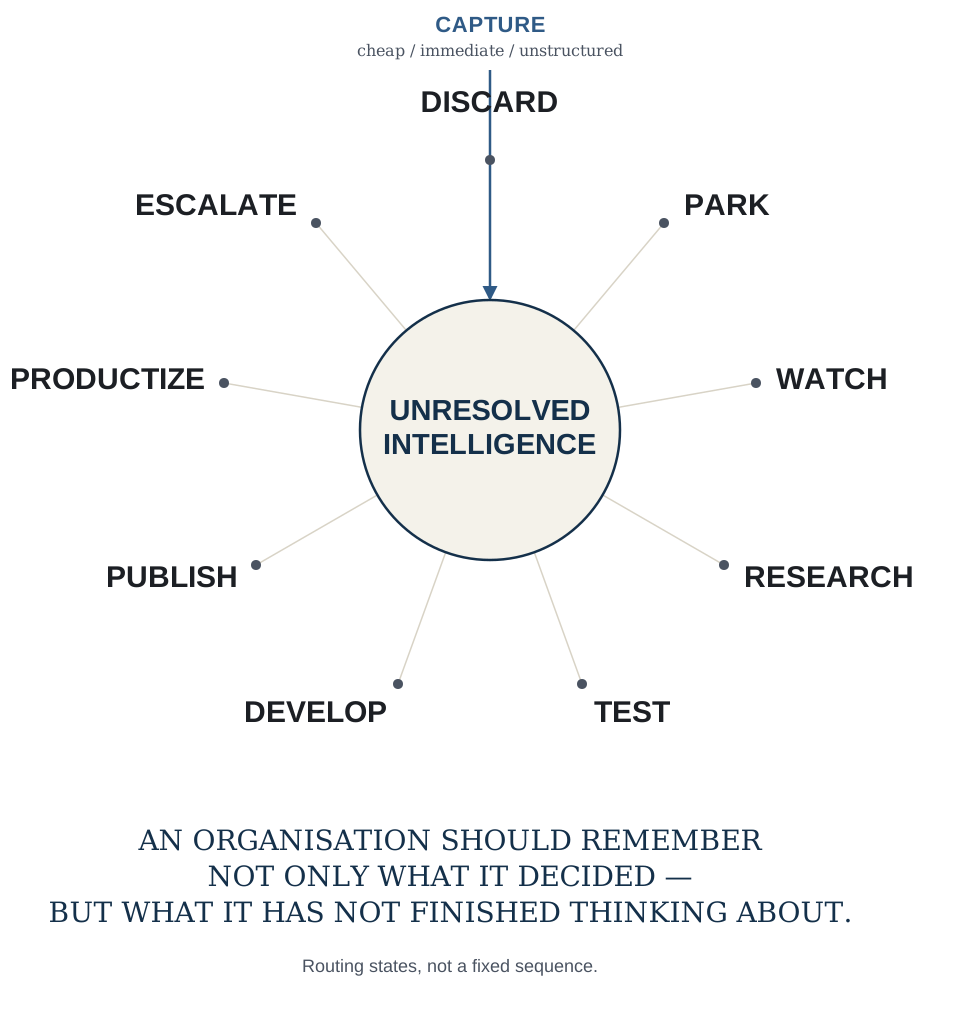
An idea can be parked because it is good but premature.
Something can be watched because external conditions may change.
An assumption can be sent to research.
A hypothesis can become a test.
Research can eventually become a product.
And, crucially, the system can periodically resurrect unresolved intelligence.
How many valuable ideas disappear today simply because they occurred in the wrong meeting, in the wrong notebook, in the wrong chat, at the wrong time?
AI gives us the possibility of an organisation that doesn't merely remember its decisions.
It can remember its unfinished thinking.
That is a far more interesting form of institutional memory.
Autonomy without governance is just unattended spending
There is an obvious trap in all this.
If an autonomous agent can keep trying indefinitely, autonomy becomes a very efficient way to receive an impressive API bill.
So cost itself needs governance.
Each task can have a budget.
Each workflow can have a budget.
Each project can have a daily or monthly ceiling.
Retries are bounded.
Stable context is reused.
Cheap models handle cheap reasoning.
Deterministic software handles deterministic work.
Expensive intelligence is reserved for problems worthy of expensive intelligence.
An agent reaching its limit should stop, preserve state and explain why continuation is justified.
Not quietly develop a philosophical attachment to attempt number 37.
This is another reason I have become skeptical of agent demos built around sheer activity.
I don't want an organisation that looks busy.
I want one that is economically intelligent.
The unexpected benefit: AI forces better management
This is perhaps the part entrepreneurs should pay most attention to.
Designing this system forced me to make things explicit that organisations routinely leave implicit.
- What exactly is the objective?
- Who owns it?
- What authority does that person have?
- What requires escalation?
- What evidence counts?
- What is the source of truth?
- When is a decision superseded?
- How is disagreement recorded?
- What happens when somebody is unavailable?
- What is the maximum acceptable cost?
- What constitutes success?
- What should stop?
These are not AI questions.
They are management questions.
AI simply makes bad organisational design impossible to ignore because a machine cannot reliably operate around the informal assumptions, hallway conversations, political intuition and tribal memory that humans have historically used to compensate for weak systems.
In that sense, building an AI-native organisation may force founders to design better human organisations too.
And that may ultimately be more consequential than automation.
The entrepreneur's real opportunity
Entrepreneurs are unusually well positioned for this.
We already think in leverage.
Capital is leverage.
Software is leverage.
Distribution is leverage.
Teams are leverage.
AI adds another form: scalable intelligence.
But using ChatGPT twenty times a day is not yet scalable intelligence.
It is an extraordinarily capable individual tool.
The larger opportunity comes when you combine:
your judgment × your ambition × your proprietary knowledge × your human team × machine intelligence × a system capable of coordinating all of them.
That combination starts to look less like software adoption and more like organisational leverage.
The entrepreneur remains responsible for direction.
Human judgment remains responsible for consequence.
But the organisation becomes capable of researching continuously, remembering structurally, challenging its own work, executing in parallel, recovering from failures and surfacing only those decisions where human judgment creates disproportionate value.
That is qualitatively different from asking AI to write an email faster.
From one strange summer to a small team
The irony is that the journey started with productivity.
Could AI help me write this?
Could Claude build that?
Could ChatGPT fix this problem?
Could I launch something that would previously have required developers, designers, researchers and a considerable amount of money?
The answer, repeatedly, turned out to be yes.
Three books and two functioning platforms later, I have enough evidence for myself that the capability is real.
But the experiment also exposed the next bottleneck.
Me.
So the next stage isn't about becoming better at prompting.
It is about turning this collection of extraordinary capabilities into a small, coherent organisation.
One with roles.
Authority.
Memory.
Objectives.
Cadence.
Independent challenge.
Budgets.
Escalation.
Institutional intelligence.
And an operating system connecting all of it.
I don't want fifty agents.
I don't particularly care whether next year's best model is called Claude, GPT or something that does not yet exist.
I want an organisation that can wake up, understand what matters, do useful work, challenge itself, remember what it learned and continue making progress when I am not there.
Which leaves me with the sentence that probably best describes the transition:
Today you operate AI. The next system should operate the AI, while you operate the business.
For entrepreneurs and decision-makers, I increasingly think that is where the real leverage begins.
Not artificial intelligence replacing human intelligence.
Not automation replacing leadership.
But a deliberately designed system in which human judgment, ambition and accountability can finally operate with machine intelligence at organisational scale.
That is a considerably more interesting future than another chatbot.
Filed under: AI Leadership · Agentic AI · Operating Model · Entrepreneurship · Hybrid Leadership · Future of Work