The CEO Bottleneck
AI needs executive ownership. It does not need executive dependency.
Two recent BCG studies reveal an interesting tension at the top of organizations.
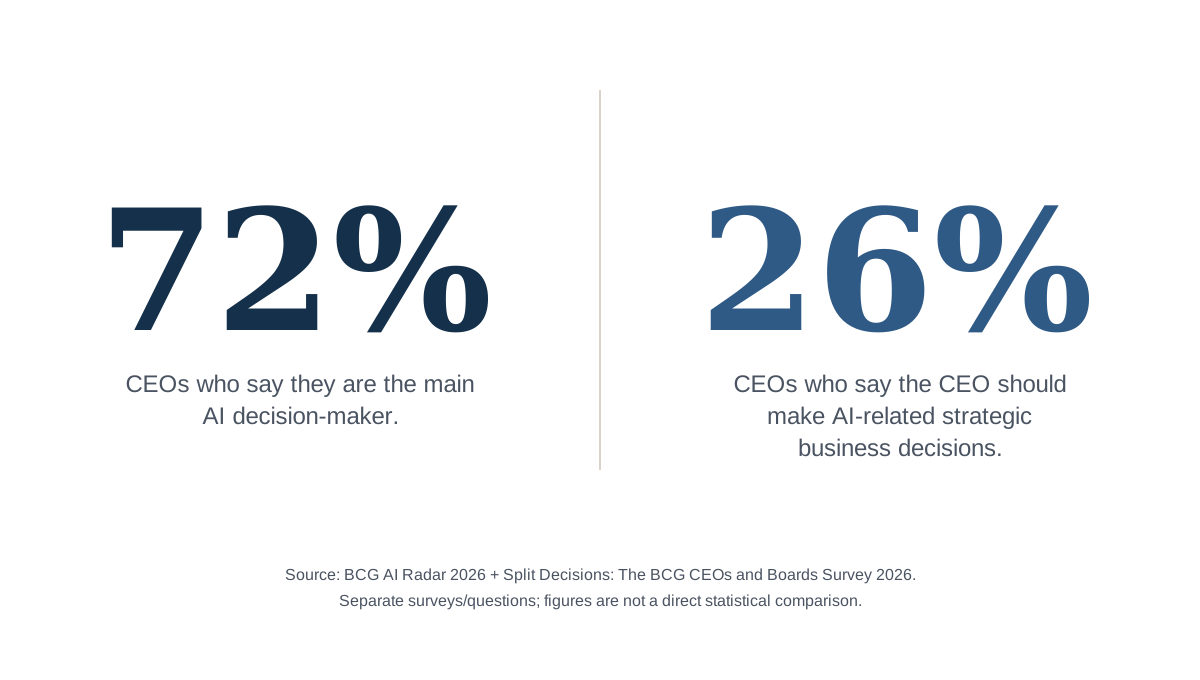
In its 2026 AI Radar, BCG found that 72% of CEOs describe themselves as the main decision-maker on AI, more than twice the proportion reported a year earlier. In a separate survey of CEOs and board members, only 26% of CEOs said the CEO should be the one making AI-related strategic business decisions. The two studies use different samples and questions, so the percentages should not be treated as a direct statistical comparison. But the tension is revealing.
AI has become too strategically important for CEOs to delegate and forget. At the same time, concentrating too much AI authority, interpretation and execution around the CEO can create exactly the opposite of what the technology promises.
Instead of accelerating the organization, the CEO becomes its newest bottleneck.
AI transformation may need to begin at the top. It cannot remain concentrated there.
Why the CEO moves to the center
There are good reasons why CEOs are taking a more active role.
AI is no longer simply an IT investment or productivity tool. It increasingly affects how organizations analyse markets, allocate resources, design work, interact with customers, develop products and make decisions. It touches strategy, operating models, talent and, increasingly, the distribution of authority itself.
A CEO who treats that as someone else's technology program is taking a considerable risk.
Personal engagement matters too. BCG's research on CEOs using AI found leaders employing it to learn unfamiliar subjects, synthesize complex information, stress-test assumptions, prepare for difficult conversations and challenge their own thinking. BCG also found that when CEOs use AI themselves, they send a signal through the organization that encourages managers and employees to experiment and makes clear that AI is not somebody else's project.
This is the useful part of CEO ownership.
The leader learns enough to distinguish possibility from hype. The executive team sees that experimentation is legitimate. AI becomes connected to strategy rather than confined to a specialist function.
The problem begins when ownership quietly turns into dependency.
BCG now makes that distinction explicitly. In its July 2026 research on scaling AI value, it argues that the CEO should orchestrate AI while the business remains accountable for delivery. A CEO who becomes too directly involved in execution risks becoming a bottleneck rather than a catalyst; execution belongs with CXOs and P&L owners.
That distinction becomes even more important because AI is changing not only who produces intelligence, but how much of it an organization can produce.
When answers become cheap
For most of management history, good analysis was expensive.
It required time, people, expertise and access to information. A new strategic option might require weeks of research. A scenario needed analysts. A synthesis required someone to read the material. An executive recommendation usually arrived after a substantial amount of human work.
AI changes the economics of the answer.
A leader can now ask for another analysis, another scenario, another counterargument, another draft, another interpretation or another set of recommendations almost immediately. BCG describes CEOs already using AI as tutors, strategic editors, sparring partners and devil's advocates, compressing large volumes of information and stress-testing decisions before they harden.
That is enormously valuable.
It also creates a new problem.
When the cost of producing an answer collapses, the number of answers rises.
More analysis does not automatically create more clarity. More alternatives do not remove the need to choose. More recommendations do not resolve competing priorities. Producing intelligence faster does not expand a human being's capacity to absorb, challenge and act on it at the same rate.
BCG describes the same tension from another angle. AI can compress the path from question to answer, while executives still need time to absorb, challenge and decide. And because humans still have to review, judge, reconcile and determine what to trust, AI-generated information can increase cognitive overload rather than reduce it.
The problem is no longer simply information scarcity.
It is intelligence abundance without a corresponding increase in distributed judgment.
And that is where the CEO bottleneck emerges.
A faster organization can still have a slow top
Imagine an organization where every function becomes substantially better at producing options.
Marketing arrives with five campaign scenarios instead of two. Finance models multiple capital-allocation alternatives before lunch. Strategy continuously monitors competitors. HR generates workforce scenarios. Operations receives increasingly granular recommendations. AI agents identify anomalies and propose corrective actions before executives have asked the question.
The organization has become faster at producing intelligence.
But if the important conclusions, trade-offs and decisions still move upward to the same small group of people, the decision architecture has barely changed.
The queue has simply become better informed.
This is an old organizational problem in a new form. Senior leaders have always been capable of becoming approval bottlenecks. AI amplifies the phenomenon because the volume and speed of what can be prepared for their attention increases dramatically.
The scarce resource moves.
It was once information. Then expertise. Increasingly, it is judgment: deciding what deserves attention, what matters, what can be delegated, what should be challenged and what requires an accountable human decision.
The question is therefore not whether the CEO should be involved in AI.
The better question is: what should continue to require the CEO once intelligence becomes abundant throughout the organization?
Two very different companies offer useful clues.
Shopify: model the behavior, then distribute it
Shopify is an obvious example because its culture makes experimentation relatively natural.
In April 2025, CEO Tobi Lütke circulated the memo that made “reflexive AI usage” a baseline expectation at Shopify. But the more interesting part is what followed.
Shopify did not translate CEO enthusiasm into a centralized approval process. It translated it into distributed behavior.
By October 2025, Shopify reported universal adoption of AI code editors, thousands of Cursor licences, near-constant usage of its internal AI tools and unlimited access to leading AI models for every team. The company describes a culture built around experimentation, sharing and allowing employees to discover useful applications through direct use rather than waiting for every experiment to begin with a formal business case.
The CEO signal mattered.
But the signal was effectively: use this, learn this, challenge your existing way of working — not bring every meaningful AI decision back to me.
A CEO can create permission without creating dependence.
Shopify's culture undoubtedly makes that easier. It is a technology company built around experimentation. It would be reasonable to ask whether the same principle survives in a business with enormous physical operations, frontline employees and decades of organizational complexity.
Walmart provides a useful counterpoint.
Walmart: distribute capability into the work
Walmart represents almost the opposite organizational context.
Its AI strategy is not confined to a small group of technologists. The company has been pushing AI directly into workflows used by merchants, designers, managers and frontline associates.
Its Trend-to-Product system uses AI and generative AI to analyse trends and support fashion design. Walmart reports that the system can shorten the traditional fashion production timeline by as much as 18 weeks, taking parts of research and design that once required weeks down to minutes while designers and merchants remain responsible for refining the output and making final product choices.
At store level, Walmart announced AI-powered tools for its 1.5 million U.S. associates. Early deployments of an AI-directed task-management tool reduced estimated shift-planning time for team leads from 90 minutes to 30. Its conversational AI platform was already being used by more than 900,000 associates each week, processing more than three million queries per day.
Its approach to agentic AI is similarly deliberate. Walmart describes its strategy as “surgical”: deploy agents for highly specific retail tasks, then connect their outputs to solve larger workflows. It is also explicitly evaluating where autonomous execution is appropriate and where human oversight and approval remain necessary.
Shopify and Walmart could hardly be more different.
One is a technology company with experimentation in its DNA. The other is one of the world's largest physical retailers.
Yet the underlying leadership principle is similar: AI capability is being pushed into the organization, closer to the work and the people who can use it, rather than accumulated as an executive capability at the top.
That is what turns CEO ownership into organizational capacity.
What the CEO mindset actually requires
This is where the idea of an AI-era CEO mindset becomes more useful than another call for leaders to “embrace AI.”
Enthusiasm is not a mindset. Neither is technical-fluency theatre.
The Hybrid CEO Mindset starts from a different premise: as intelligence becomes more abundant, the executive role has to move from being a gatekeeper of knowledge toward becoming an orchestrator of judgment.
Within the Hybrid Leadership System™, that means shifts from knowing to learning, from control to orchestration, and from instinct alone toward judgment deliberately augmented by machine intelligence.
That begins with personal use. A CEO who never works seriously with the technology will struggle to understand what should be delegated to it, where it creates genuine leverage or when its apparent confidence is misleading.
But personal capability is only the beginning.
The harder leadership discipline is deciding what must remain at the top and what should no longer need to travel there.
Some decisions legitimately belong with the CEO: enterprise strategy, consequential capital allocation, major organizational choices, risk appetite, values, leadership appointments and decisions where accountability cannot credibly be distributed.
Many others do not.
If AI allows functions and teams to access stronger analysis and broader expertise, leaders should ask whether decision rights can move closer to the people and systems with the information required to act.
Otherwise the organization democratizes intelligence while preserving an old hierarchy for judgment.
That is not transformation. It is faster preparation for the same meeting.
The CEO therefore has two jobs that can appear contradictory.
The first is to go first: experiment personally, model the behavior, ask better questions, challenge assumptions and make clear that AI is a leadership subject rather than somebody else's project.
The second is to make that personal leadership progressively less necessary: build capability in the executive team, clarify decision rights, create appropriate autonomy and ensure that the organization can act without routing every important AI-enabled judgment through one person.
The objective is not maximum delegation. Some decisions should remain human-led, and some should remain at the top.
The objective is to prevent the CEO's attention from becoming the architecture through which the entire organization's intelligence must pass.
Ownership without dependency
The irony is that AI can make a highly engaged CEO feel increasingly powerful.
More information becomes accessible. More questions can be explored. More decisions can be prepared. More parts of the organization can be observed from the center.
That is precisely why discipline matters.
The CEO who uses AI to see everything may eventually be tempted to decide everything.
The stronger model is different: use the technology to improve executive judgment, then use leadership to distribute capability and authority where they belong.
AI needs executive ownership.
It does not need executive dependency.
The CEO must go first. But if every meaningful AI-enabled decision still has to go through the CEO, the company has not built transformation. It has built dependence.
Sources
- Boston Consulting Group — AI Radar 2026: “As AI Investments Surge, CEOs Take the Lead”Source for the 72% CEO decision-maker figure and the growth in CEO ownership of AI.
- Boston Consulting Group — “CEOs and Boards Are Aligned on AI in Theory, but Divided in Practice”Global survey of 625 CEOs and board members; source for the 26% figure and the distinction between CEO-led implementation and executive-team ownership.
- Boston Consulting Group — “CEOs Are Starting to See Value from AI. Now Comes the Hard Part.”Source for the argument that the CEO should orchestrate AI while CXOs and P&L owners remain accountable for execution, and for BCG's explicit CEO-bottleneck warning.
- Boston Consulting Group — “AI for CEOs: Amplifying Time and Judgment at the Top”Source for CEO use cases, cognitive overload, AI-supported judgment and the distinction between faster answers and better decisions.
- Shopify — “Serious Results, Unserious Methods: Shopify's AI Playground”Company-reported evidence on reflexive AI use, access to models, AI code-editor adoption and distributed experimentation.
- Walmart — “In an Ever-Changing Environment, Walmart Uses GenAI To Create Cool for Customers”Company-reported evidence on Trend-to-Product and the reduction of the fashion product-development timeline by up to 18 weeks.
- Walmart — “Walmart Unveils New AI-Powered Tools To Empower 1.5 Million Associates”Company-reported evidence on associate adoption, conversational AI usage and shift-planning time.
- Walmart — “Inside Walmart's Strategy for Building an Agentic Future”Source for Walmart's purpose-built agent strategy and explicit approach to human oversight versus autonomous execution.
- The Hybrid CEO — “The Hybrid Leadership System™: 8 Questions Every Leader Needs to Answer in the Age of AI”Source for the Hybrid CEO Mindset and the broader leadership-system connection.
Filed under: AI Leadership · CEO Leadership · Hybrid Leadership · Decision Making · Organizational Transformation